

The Ultimate Uyuni Salt Flats Travel Guide: Bolivia's Most Surreal Bucket List Destination

Few places on Earth feel like they belong more on another planet than the Uyuni Salt Flats in Bolivia. Stretching endlessly across the Altiplano, shimmering under impossible light, and shifting between cracked desert and mirror-like water, this is one of those rare destinations that actually lives up to — and exceeds — the hype.
If there’s one place that deserves a spot on your bucket list, it’s the Uyuni Salt Flats in Bolivia.
Below is your complete travel guide: history, logistics, what to expect, and everything we wish we knew before going
Why Salar de Uyuni belongs on your bucket list
The Salar de Uyuni is the world's largest salt flat, covering more than 10,000 square kilometres in southwestern Bolivia. Thousands of years ago, this region was covered by a massive prehistoric lake known as Lake Minchin. When the lake eventually evaporated, it left behind vast layers of salt and minerals that formed the extraordinary landscape visitors see today.
Today, the salt crust is several metres thick in places and contains an estimated 50-70% of the world's known lithium reserves beneath its surface. While travellers visit for the incredible scenery, the flats also play an important role in the global supply chain for electric vehicle batteries and smartphones.
The result is a landscape unlike anything else on Earth.

Getting there & Logistics
Uyuni is remote — and that’s part of its magic. The salt flats are located in southwestern Bolivia near the town of Uyuni, which serves as the main gateway for visitors. Most travellers reach Uyuni via:
Domestic flight from La Paz (approximately 1 hour)
Overnight bus from La Paz (8-10 hours)
Tour crossing from Chile's Atacama Desert
Multi-day Bolivia overland itineraries
We flew into Uyuni from La Paz and found it by far the easiest option. Note that its also the most expensive, and BoA airlines (although fine on the day) does not have a very user friendly website or ticket confirmation. Our hotel in La Paz kindly helped us check in and print our boarding passes!
Option 1: The Classic 1-Day Tour
Perfect if your main goal is experiencing the salt flats themselves. You'll typically visit:
Train Cemetery
Salt processing areas
Salar de Uyuni
Isla Incahuasi (Cactus Island)
Perspective photo stops
Sunset on the salt flats
This is the option we chose.
Option 2: The 3-Day Expedition
The longer route includes everything above plus:
Red and green lagoons
Flamingo-filled lakes
Volcanic landscapes
Geysers
Hot springs
Desert scenery
Border crossing into Chile's Atacama Desert
Many travellers combine Uyuni and Atacama using this route.
We opted for the 1-day experience since we had already explored the Atacama region previously — and honestly, even one day feels otherworldly. But if you have the time and are new to this part of the world, do not even hesitate one bit and book the 3-day tour!

Our experience with Andes Salt Expeditions
Here’s the truth: almost every Uyuni tour follows the exact same route.
So what actually changes?
Comfort.
We booked with Andes Salt Expeditions and had a 4x4 with just five people total, including our driver — which made a huge difference in comfort, space, and overall experience. Some operators pack up to 8 people per vehicle. That might not sound like much, but when you're spending hours in a 4x4 across bumpy terrain, it matters more than you think. If you’re deciding where to book, this is the one thing we’d prioritize over almost anything else.
One thing worth noting: your guide becomes your unofficial photographer for the day. And they take this responsibility very seriously. Expect creative perspective photos, forced-perspective tricks, funny poses, and plenty of enthusiasm. Even if you're not usually into these kinds of photos, embrace it. It's part of the Uyuni experience.

Stop 1: The Train Cemetery (Cementerio de Trenes)
Every Uyuni adventure begins in one of South America's strangest attractions.
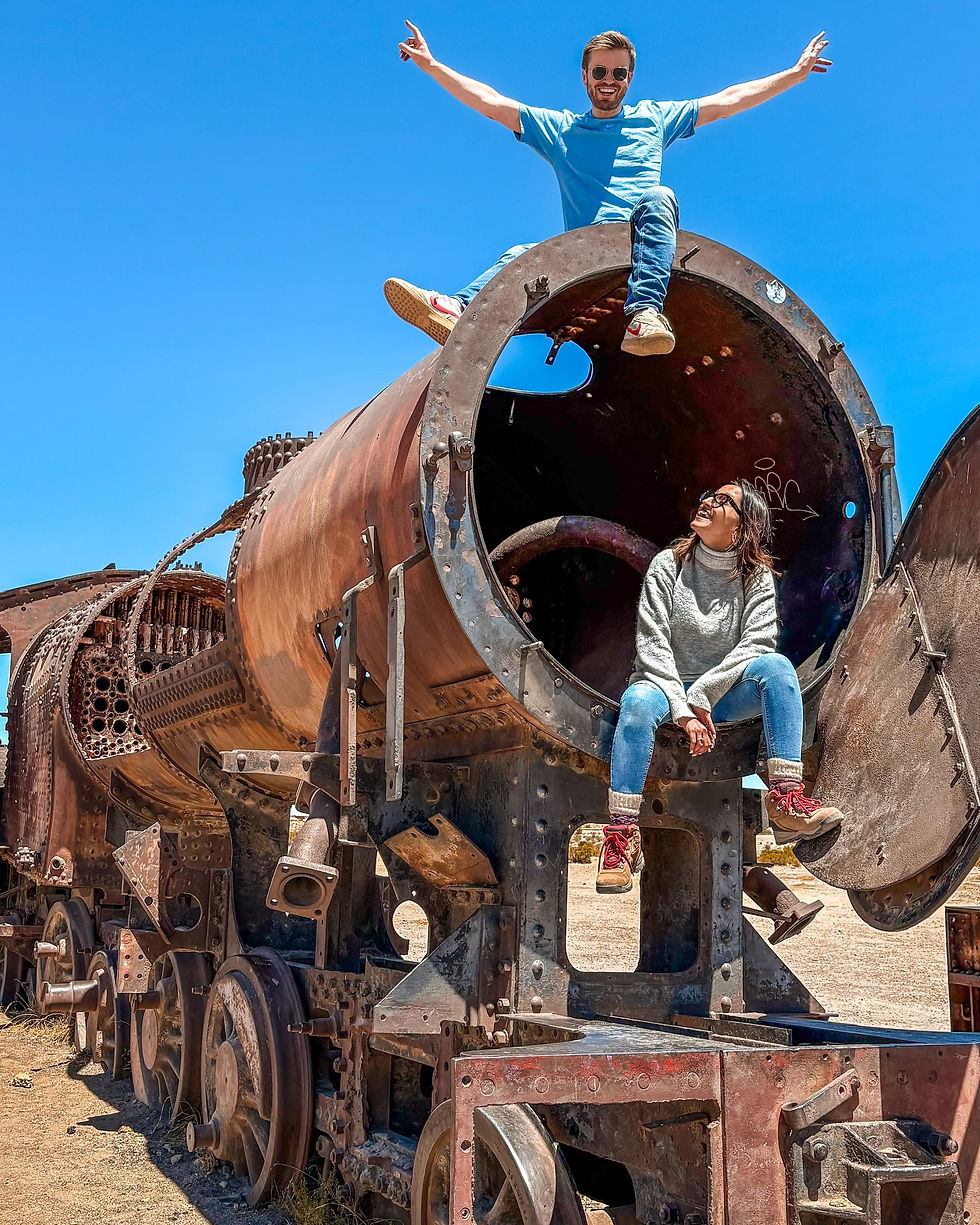
Just outside town sits a vast collection of rusting locomotives and abandoned railcars scattered across the desert. At first glance, it looks like the set of a post-apocalyptic movie. But there's real history here.
In the early twentieth century, Uyuni was a major railway hub connecting Bolivia's mining industry to ports in Chile and Argentina. When mining declined in the 1940s, many trains were abandoned where they stood. Over decades, wind, salt and sun slowly transformed them into giant steel sculptures.
Fun fact: many of the locomotives were built in England in the late 1800s. Today, they're among Bolivia's most photographed landmarks.
PRO TIP: Safety regulations seem surprisingly relaxed here. Visitors are free to climb on many of the trains, creating fantastic photo opportunities. Just be careful of rusted metal, loose parts, and sharp edges.
Stop 2: The Salt Flats
Nothing prepares you for that first glimpse.
One moment you're driving through dusty high-altitude landscapes. The next, the world suddenly becomes white. The scale is difficult to describe. There are no mountains immediately nearby. No trees. No buildings. Just an endless horizon of brilliant white salt stretching in every direction. The dry season reveals beautiful hexagonal salt formations, creating the famous geometric patterns often seen in photographs. Meanwhile, the wet season transforms the landscape entirely - a thin layer of water creates a mirror so perfect that the sky appears to continue beneath your feet.
One thing we quickly noticed is how completely your sense of distance disappears. Walk only a few metres from your vehicle and suddenly everything looks identical. It's one of the reasons perspective photography works so well here. Your brain simply can't tell what's close and what's far away.
This is also where we had lunch - all the tour companies come together to dine at this little hut, which is full of picnic tables (one for each group).

Stop 3: Isla Incahuasi (The Cactus Island)
Just when you think the landscape can't get any stranger, a giant island covered in cacti appears in the middle of the world's largest salt flat. Welcome to Isla Incahuasi.
This rocky outcrop is actually the remnant of an ancient coral reef that existed when the prehistoric lake covered the region. Today it's home to hundreds of giant cacti, some exceeding 10 metres in height! Considering these cacti grow roughly one centimetre per year, some are estimated to be more than a thousand years old. The short hike to the summit is absolutely worth it. From the top, you'll enjoy panoramic views across what looks like a frozen white ocean.
PRO TIP: Bring cash. There is a separate entrance fee to access the island, and card payments are not accepted. Also, don't underestimate the altitude. At roughly 3,600 metres above sea level, even a short climb can leave you surprisingly out of breath.

Stop 4: Sunset and the famous Mirror Effect
This is the moment everyone comes for. And somehow, it's even better than expected.
As mentioned above, during the rainy season, a thin layer of water covers parts of the salt flats. We visited in October which is not part of the rainy season, but fortunately there was a little pool of rainwater gathered in one of the lower parts of the flats, and we all headed there in anticipation.
The result is one of the most extraordinary natural phenomena on Earth. The sky reflects perfectly onto the surface below. Clouds float beneath your feet. Mountains appear suspended in space. People become silhouettes standing between two worlds.
Ok thats a bit poetic, but honestly, as sunset approaches, the colours become even more dramatic. Blues.
Golds. Purples. Pinks.
Our guide found a pristine section of water free from footprints and tyre tracks before setting up a simple picnic with snacks and wine. It was one of those travel moments that instantly becomes a lifelong memory.
Not because it was luxurious. Because it felt completely unreal.

What to wear at the Uyuni Salt Flats
One of the most useful things we learned: dress for every season in a single day. Conditions change dramatically. Expect:
Freezing temperatures at sunrise
Strong sun by midday
Cold winds at sunset
Layers are essential. We recommend:
Base layer
Fleece or sweater
Windproof jacket
Sunglasses
Sunscreen
Hat
If you're visiting during mirror season, don't worry about special footwear - most tour operators provide rubber boots.
Do you need an English-speaking guide?
Not necessarily.
Most information shared during the tour is fairly basic and can easily be researched beforehand. If someone in your group speaks Spanish, you'll likely be fine. That said, if you enjoy learning local stories and chatting throughout the day, an English-speaking guide can add extra depth to the experience.
Where to stay in Uyuni
Uyuni itself is a very small town. Most travellers arrive, take their tour, and move on. However, if you do decide to stay overnight, one of the most unique and budget-friendly options is Casa de Sal. Built largely from salt blocks, it's one of the most famous accommodations in the region and perfectly fits the unusual nature of the destination. It's worth staying simply for the novelty!
The Travel with the Laws Lowdown
Vibe: One of the most surreal natural wonders on Earth.
Best For: Bucket-list travellers, photographers, couples, adventure seekers, and anyone who loves landscapes that don't feel real.
Would We Go Again? Absolutely. The mirror effect alone is worth crossing continents for. Some destinations photograph well but disappoint in person. Uyuni is the opposite. No camera truly captures the scale, silence, and otherworldly beauty of standing in the middle of the world's largest salt flat.
It's one of those places that reminds you why travel is so addictive in the first place.


Comments